It turns out this is how HPV actually comes about
According to relevant disease reports, cervical cancer ranks third among malignant tumors in women aged 15 to 44 in China and has become the second leading cause of cancer-related deaths in this age group. Nearly all cases of cervical cancer (99.7%) are associated with HPV infection in the reproductive tract, and infection with high-risk HPV (HR-HPV) is a necessary condition for the development of cervical cancer.
Does an HPV infection always lead to cervical cancer? What are the transmission routes of HPV? Are there effective treatments available today? How can it be prevented in daily life? The high prevalence of HPV among Chinese women has also triggered public anxiety. To address these common concerns, let's explore what we need to know about HPV.
Sexual contact is the primary but not the only transmission route.
HPV can infect humans through various pathways, with sexual contact being the main mode of transmission, though not the sole one. In daily life, special attention should be paid to the following transmission routes:
The most common mode of transmission is through sexual contact. Even if no actual sexual intercourse occurs, any skin-to-skin contact between any sexual organs can lead to the spread of the virus.
HPV can be transmitted when an infected area of the skin comes into contact with another piece of skin, and this does not necessarily involve sexual activity.
In very rare cases, HPV can be transmitted from an infected mother to her baby during childbirth, through the reproductive tract.
Although it is not common, theoretically transmission can occur through hand-to-hand contact as well. For instance, by touching the infected skin of the genitals and then touching one's own or another person's genitals.
Although HPV is not easily transmitted through non-living surfaces, in rare cases, there is a risk of infection if personal items used by an infected person (such as towels or razors) are used.
HPV generally does not spread through water sources, swimming pools, bed sheets, or toilet seats. Additionally, HPV infection has a certain degree of self-limitation. If it is a first-time infection (not HPV type 16 or 18) and there are no symptoms, the condition can be monitored through follow-up examinations, and no special treatment is necessary.
80% of women have been infected with HPV at some point in their lives, but most of these infections are temporary. If the body's immune system is functioning normally, usually within 1-2 years, 90% of HPV will be cleared by the immune system. Only 5%-10% progress to persistent infections, among which approximately 30% will develop into CIN grade I, 10% into CIN grade II, and 10% into CIN grade III.
If no detection or timely treatment is carried out, only about 1% of the patients will eventually develop cervical cancer. From HPV infection to the development of cervical cancer, it goes through four stages: persistent high-risk HPV infection → cervical low-grade intraepithelial lesion (LSIL) → cervical high-grade intraepithelial lesion (CIN II/CIN III) → invasive cervical cancer. This is a long process from gradual change to sudden change, from quantitative change to qualitative change, which typically takes several years to over a decade, or even several decades.
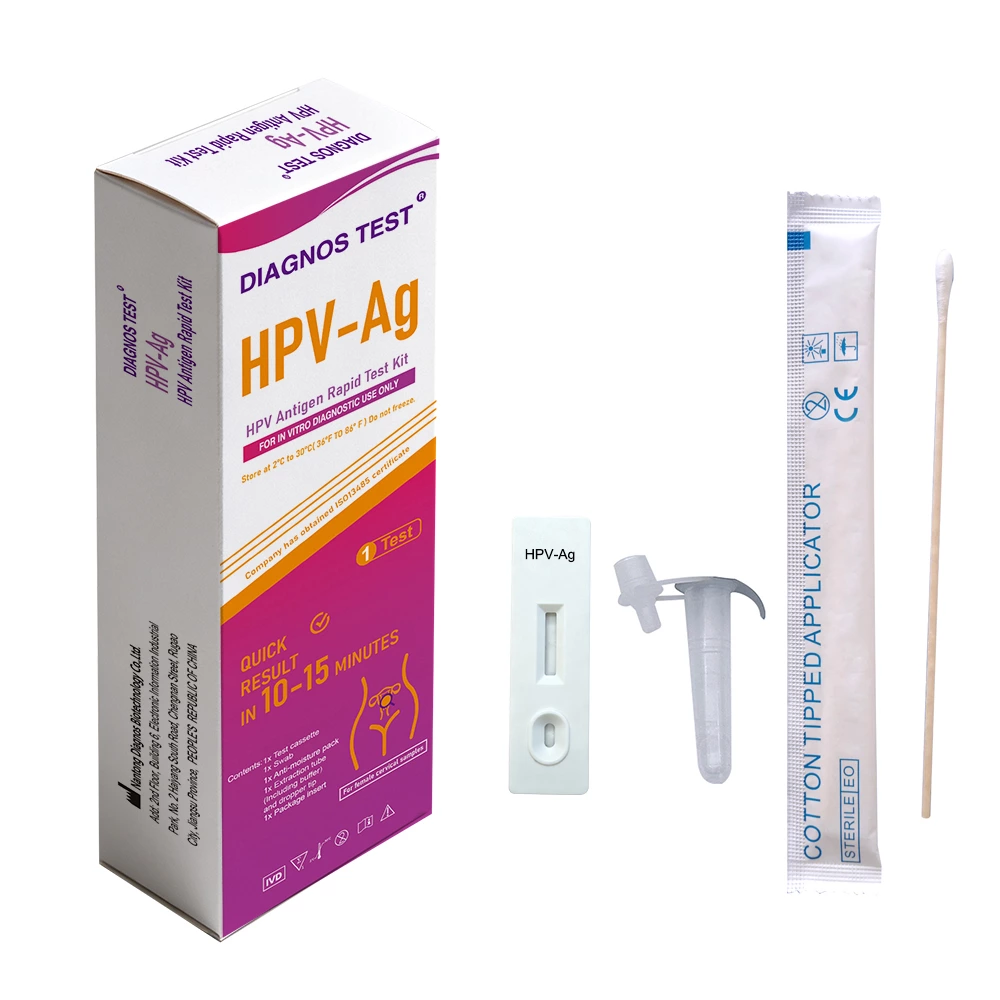
The HPV 16/18 Antigen Test Kit is used for the qualitative detection of HPV 16/18 E6&E7 oncoproteins in female cervical swab specimens. This kit is intended to be used as an aid in the diagnosis of Cervical Pre-cancer and Cancer.
In developing countries, cervical cancer is a leading cause of cancer related death of women, due to the lack of implementation of screening tests for cervical pre-cancer and cancer. A screening test for low resource settings should be simple, rapid, and cost effective. Ideally, such a test would be informative regarding HPV oncogenic activity.
Expression of both HPV E6 and E7 oncoproteins is essential for cervical cell transformation to occur. Some research results demonstrated a correlation of E6 &E7 oncoprotein positivity with both severity of cervical histopathology and risk for progression. Hence, E6&E7 oncoprotein promises to be an appropriate biomarker of HPV-mediated oncogenic activity.